Education in the US is the dream of many students worldwide. US universities are renowned for their high-quality education, career opportunities, and cultural advantages. In this article, we'll explain how to apply to a US university, what to consider when choosing an institution, the requirements they impose, and how to prepare for this important step in your life.
Why study in the USA?
The United States is one of the world's leading educational institutions. Every year, thousands of students from around the world choose American universities to pursue their degrees, as a U.S. education offers numerous advantages:
1. World University Rankings
American universities regularly rank high in international rankings. US universities such as Harvard, Massachusetts Institute of Technology (MIT), Stanford University, are recognized as leaders in various fields of science, technology, medicine and business.
2. Opportunities for career advancement
Graduating from an American university opens up broad job prospects not only in the US but also around the world. Most US universities offer internship programs and employment assistance to their students.
3. Scholarships and financial aid
Many American universities offer scholarships and financial aid to international students, which can significantly reduce the cost of tuition and living in the United States.
Steps to Apply to a US University
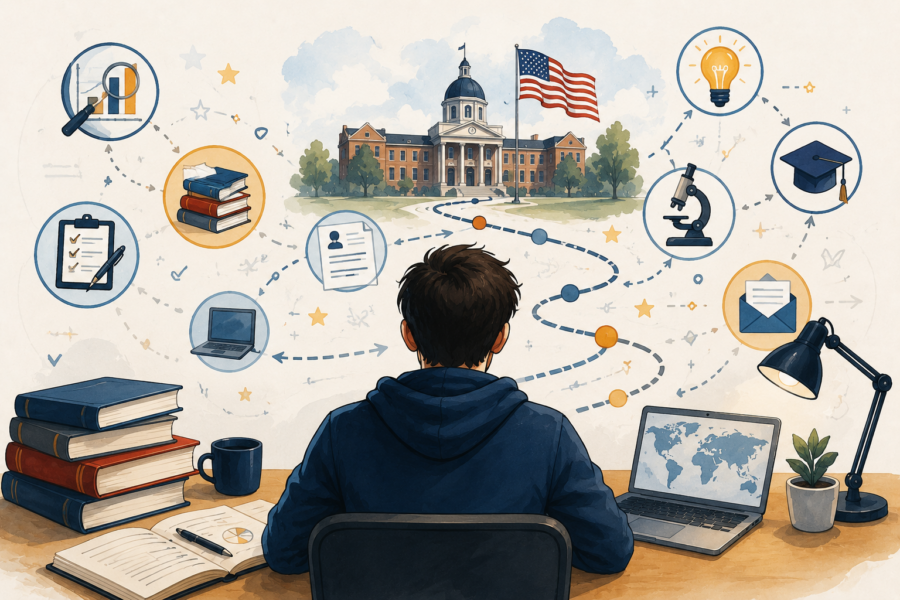
Applying to a US university can be a complex process, but with a systematic approach, each step becomes clearer. Let's look at each step in more detail.
1. Selecting a training program
The first step in the admissions process is choosing a training programBefore applying to US universities, you need to decide on the program and program type. US universities offer a wide range of educational programs, from undergraduate to graduate and doctoral.
Bachelor's degreeThis is the basic level of higher education, which lasts four years. Students study core subjects in their chosen specialty and can choose additional electives to deepen their knowledge.
Master's degreeThis program is for students who already hold a bachelor's degree. It lasts from 1 to 2 years and allows them to gain deeper knowledge in their chosen field.
Doctoral studies (PhD)This is the highest academic degree, requiring 3 to 7 years of study and research. Admission to a doctoral program requires not only excellent academic results but also the ability to conduct independent research.
At this stage, it is important to clearly understand what profession or career you want to build in the future in order to choose the right program.
2. Preparation of necessary documents
Preparing documents for admission to US universities requires careful attention and timeliness. Here's a list of the necessary documents you may need:
Motivation letter A motivation letter is a letter in which you explain your motivation for applying to this particular university, why the chosen program interests you, and how it will help you advance your career. A motivation letter should be personalized, clear, and sincere.
Letters of recommendation — US universities require applicants to provide recommendations from professors, mentors, or employers who can attest to your academic achievements, work qualities, and potential.
Resume (CV) — Your resume should include information about your educational background, professional experience, research, and any other achievements that can demonstrate your preparedness.
Transcripts and grades - You will need to provide official documents confirming your academic achievements, such as high school transcripts or college diplomas.
Exam results — Most American universities require standardized tests:
SAT or ACT for bachelor's degree.
GRE for master's degree and GMAT for business schools.
Language tests — Since most US universities teach in English, you will need to pass a language proficiency test:
IELTS or TOEFL — to confirm your level of English.
3. Submitting an application
The system used to apply to US universities is Common Application, which allows you to apply to multiple universities simultaneously. However, it's important to remember that each university may have its own requirements and deadlines, so carefully review the information on the institution's official website.
Please remember that applying often requires paying an application fee, which can range from $50 to $150 per institution.
4. Passing the interview
Some universities require an interview as part of the admissions process. This can be either an in-person or online interview. The interview is designed to assess your motivation, communication and problem-solving skills, and subject knowledge. Be prepared for questions about your academic background, career plans, and motivation to study at your chosen university.
5. Waiting for results
Once you've submitted all your documents and passed your interview (if applicable), all you have to do is wait for a decision. Admissions results typically arrive 1-3 months after the application deadline. During this time, it's important to stay in touch with the university if you have any further questions. Also, be prepared for any potential offers. conditional admission, if you lack certain test scores or the required level of English.
6. Obtaining a visa and preparing for studies
Once you receive a positive response from the university, you need to apply for a student visa. F-1To do this, you will need to attend an interview at the US consulate, provide confirmation of enrollment in an educational institution, and proof of financial solvency.
Once you receive your visa, you can begin preparing for your studies—looking for housing, obtaining health insurance, and preparing to adapt to a new cultural environment.
Requirements for exams and language tests
To enroll in a US university, you must pass several exams that confirm your academic preparedness and knowledge of English:
1. IELTS or TOEFL
If your native language is not English, you will need to take one of the language tests. TOEFL And IELTS — These are the two most popular tests for admission to US universities.
2. SAT and ACT
To be admitted to a bachelor's degree in the United States, you must pass one of these exams. SAT assesses skills in mathematics, reading and writing, and ACT also includes a section on science.
3. GRE and GMAT
To apply for a master's degree in the US, many universities require passing GRE (General Test) or GMAT (for business schools). These exams assess analytical, mathematical, and verbal skills.
Life in the USA for International Students
Once you've been accepted to a US university and arrived in the country, a new chapter of your life begins. Student life in the US isn't just about studying, it's also about a wealth of new experiences and opportunities. Let's look at the key aspects of student life in the US.
1. Accommodation
There are several housing options for international students in the United States:
Accommodation — the most popular option for first-year students. Dormitories offer convenient locations, proximity to academic buildings, and on-site amenities.
Rented apartment or room Many students prefer to rent off-campus housing to have more freedom. This could be an apartment or a room in a house they share with other students.
Hotels or apartments for rent — In large cities and areas close to universities, you can find apartments for short-term rent.
It's important to arrange accommodation in advance to avoid problems upon arrival. Make sure you have a reliable source for finding accommodation and consider your options for the first few days.
2. Student visa
In order to study in the USA you need F-1 student visaWith this visa, you can study at a university, work on campus (up to 20 hours per week), and participate in some internship programs. However, working off-campus (for example, in a restaurant or store) without permission is illegal. To obtain the visa, you will need to attend an interview at the US consulate and provide several documents, including a letter of acceptance, financial evidence, and proof of sufficient funds to cover expenses.
3. Work while studying
International students are allowed to work on campus, which helps cover some expenses. However, there is a limit: students can work no more than 20 hours per week during the academic year and up to 40 hours per week during vacations. Furthermore, if you wish to work off-campus, you will need special permission from the university or immigration authorities.
4. Interaction with local culture and student life
In the US, students actively participate in cultural and athletic life. Universities offer numerous clubs, extracurricular activities, volunteer programs, and sports teams. This is a great opportunity to meet new people, improve your communication skills, and immerse yourself in American culture.
In addition, the United States often hosts various events, competitions, and festivals that help students from different countries establish communication and broaden their horizons.
5. Healthcare
All students in the US are required to have health insurance. Many universities provide their students with insurance through a university plan that covers basic medical care. However, if you prefer, you can choose private insurance.
Financial Aspects of Studying in the USA
Studying in the US can be expensive, but there are several ways to reduce costs:
Scholarships Many universities and private organizations offer scholarships for international students. These can provide full or partial compensation for tuition fees.
Grants - There are grants that are provided to students to cover part of their educational expenses.
Financial assistance — Many universities offer financial aid programs, which may include loans or on-campus work.
Conclusion
Applying to a US university is a challenging yet exciting process that opens up a wealth of opportunities. With proper preparation and planning, you can successfully navigate all application stages and begin your studies at one of the world's top educational institutions. It's important to prepare your documents, take the required exams, and select the right program in advance. Best of luck on your journey to educational success in the US.